
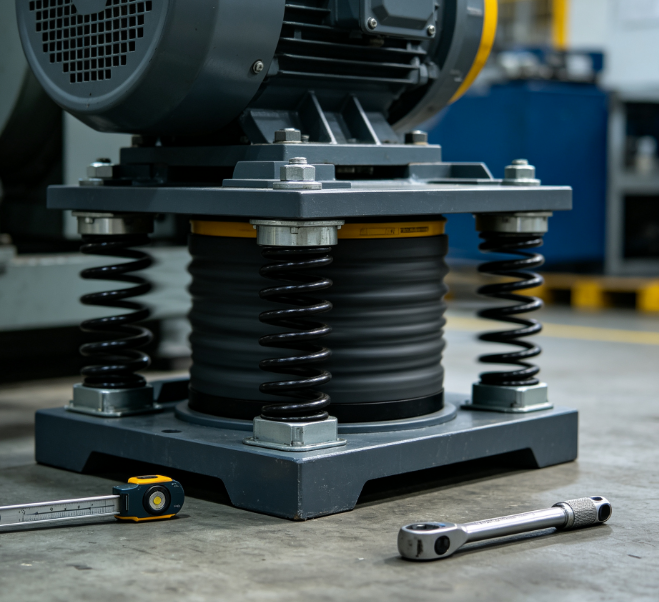
If you've ever dealt with a piece of machinery that just won't stop shaking, you know the frustration. You've tried stiffer mounts, you've added dampers, you've even changed the operating speed—but that annoying vibration keeps coming back. And sometimes, the root cause isn't the motor or the coupling. It's the spring.
I've been in enough plant-floor troubleshooting sessions to know that vibration control is often treated as a black art. People throw dampers at the problem, or they just over-design the structure to brute-force the issue. But there's a simpler, more elegant solution that too many engineers overlook: the barrel spring.
Barrel springs—also called hourglass or convex springs—have been around for decades, but they're still underutilized in many industrial applications. And that's a shame, because when it comes to stability and vibration control, they offer some unique advantages that cylindrical and even conical springs simply can't match.
Let's walk through what barrel springs are, why they work so well for stability and vibration damping, and how you can apply them in your next design.
What Is a Barrel Spring?
A barrel spring is a type of compression spring with a distinctive shape: the coil diameter is smaller at both ends and larger in the middle. Viewed from the side, it looks like an old-fashioned barrel—hence the name. Some engineers call them "convex springs" or "hourglass springs" (though hourglass usually refers to the opposite shape, with a smaller middle).
The geometry is straightforward. The spring is wound with a variable pitch and varying coil diameter. The largest diameter occurs at the midpoint of the spring's free length, and the diameter tapers down toward each end.
Now, why would you want that shape? The answer lies in how the spring behaves under load. Unlike a cylindrical spring, where every coil sees roughly the same stress, a barrel spring distributes stress more evenly along its length. The larger coils in the middle carry more of the load when the spring is compressed, and the smaller end coils provide guidance and stability.
The barrel shape ensures that the spring maintains its axis better during compression. It's less prone to buckling, and it exhibits a more consistent lateral stiffness compared to cylindrical springs of similar solid height. That stability is exactly what you need when you're trying to control vibration.
How Barrel Springs Enhance Stability
Let me be direct about this. The primary reason you'd choose a barrel spring over a standard cylindrical spring is stability. And I mean stability in two senses: static stability (resistance to buckling under axial load) and dynamic stability (consistent performance under cyclic loading).
Buckling Resistance
Buckling is a common failure mode for compression springs, especially when they're long relative to their diameter. As you compress a spring, it can bow sideways—like a column buckling under a load. Once it buckles, it loses its spring rate, can rub against surrounding components, and often fails prematurely.
Barrel springs are inherently more resistant to buckling. Why? Because the larger coils in the middle provide lateral support. When the spring deflects, the middle coils act as a "belly" that counteracts sideways movement. The spring tends to remain straight, even at high deflections.
In fact, studies have shown that barrel springs have a much higher critical buckling load compared to cylindrical springs with the same solid height and wire diameter. You can achieve a given deflection with a shorter barrel spring than you could with a cylindrical spring, reducing the slenderness ratio and further improving stability.
Lateral Stiffness
Another aspect of stability is lateral stiffness—the spring's resistance to side loads. In many applications, the spring isn't perfectly axially loaded; there's always some misalignment or side force. A barrel spring's variable diameter gives it a higher lateral stiffness than a cylindrical spring of the same axial rate. That means it can withstand off axis forces without binding or shifting.
This is especially valuable in applications where the spring is mounted in a guide tube or over a rod. The barrel shape centers itself better, reducing wear on both the spring and the guide surfaces.
Vibration Control Mechanisms
Now let's talk about vibration. Because that's where barrel springs really earn their keep.
Progressive Spring Rate and Natural Frequency
A barrel spring doesn't have a constant spring rate like a cylindrical spring. Because the coils have different diameters, they have different stiffnesses. As the spring is compressed, the smaller coils—which are stiffer—tend to come into contact with each other and "go solid" before the larger coils. This creates a progressive spring rate: the spring gets stiffer as it deflects.
Why does that matter for vibration? Vibration control is all about managing the system's natural frequency. If you have a constant spring rate, you have a single natural frequency. If the excitation frequency matches that, you get resonance—and that's where vibrations get amplified.
A progressive spring rate shifts the natural frequency as the load changes. This effectively "detunes" the system, preventing resonance from building up. The spring can also absorb shock loads more effectively because the progressive rate provides a softer initial response but firmer bottoming resistance.
Hysteresis and Damping
Barrel springs also exhibit greater inherent damping than cylindrical springs. Damping is the ability to dissipate energy—to turn vibration into heat. The friction between coils (especially when they make contact during compression) and the internal material damping combine to provide a damping effect that's higher than a standard spring.
In applications where you can't easily add external dampers, this intrinsic damping can be a lifesaver. It reduces the amplitude of vibrations and helps the system settle faster after a disturbance.
Reducing Transmitted Force
When a spring is used as an isolator, the goal is to reduce the force transmitted from a vibrating machine to its foundation, or from the foundation to sensitive equipment. Barrel springs, with their progressive rate and higher damping, can achieve better isolation over a wider frequency range than a linear spring. They're particularly effective at high frequencies, where their nonlinearity creates a "softening" effect that further reduces transmissibility.
Design Parameters That Matter
Designing a barrel spring isn't as straightforward as a cylindrical spring, but it's not rocket science either. Here are the key parameters you need to consider:
Wire diameter: Affects both stiffness and stress. Thicker wire = higher rate but also higher stress at a given deflection.
Mean coil diameters: You need to specify the end diameter, the middle diameter, and the taper rate.
Number of active coils: More coils = lower spring rate but greater deflection capacity.
Pitch: The spacing between coils. A variable pitch is typical to achieve the progressive rate.
Free length and solid height: The barrel shape allows a lower solid height than a cylindrical spring of similar wire size because the coils nest partially.
End type: Closed and ground ends are common to provide flat bearing surfaces.
·
A well-designed barrel spring will have the largest stress at the middle coils, which is where the material is most effectively utilized. You can optimize the taper so that stress is nearly constant along the wire, leading to more efficient use of material and longer fatigue life.
Stress and Fatigue Considerations
Because the barrel shape distributes stress more evenly, the maximum stress is often lower than in a cylindrical spring of equivalent rate and deflection. This translates to longer fatigue life, which is critical in high-cycle vibration applications. For example, a barrel spring used in a high-speed valve might see millions of cycles; its ability to manage stress concentration at the ends (where cylindrical springs often fail) is a major advantage.
Comparison with Cylindrical and Conical Springs
Let's put barrel springs side by side with the other common types. I won't give you a long list—just the key differences.
Feature | Cylindrical | Conical | Barrel |
Shape | Constant diameter | Tapered (small top, large base) | Large middle, small ends |
Spring rate | Linear | Progressive (can be linear if designed) | Progressive |
Buckling resistance | Moderate | Moderate to good (base helps) | Excellent |
Lateral stability | Poor | Fair | Very good |
Solid height | Moderate | Very low (nesting) | Low (partial nesting) |
Vibration damping | Low | Moderate | High (due to coil contact) |
Stress distribution | Uniform along coil | Varies | More uniform, lower max stress |
Typical applications | General-purpose | Space-limited, progressive rate | Stability-critical, vibration control |
As you can see, the barrel spring occupies a sweet spot: it offers excellent stability and vibration control, with a reasonably compact solid height and good stress distribution. It's not as space-saving as a conical spring, but it beats a cylindrical spring in that regard, and it outshines both in dynamic performance.
Key Applications and Industries
Barrel springs aren't just academic curiosities. They're used in demanding real-world applications where stability and vibration matter.
Automotive and Off-Highway
In suspension systems, barrel springs provide progressive damping and excellent lateral stability. They're also used in clutch mechanisms and valve train components where consistent force is needed under high-frequency vibration.
Industrial Machinery
High-speed packaging equipment, textile machinery, and printing presses all benefit from barrel springs. They reduce unwanted motion, keep components aligned, and extend maintenance intervals.
Aerospace and Defense
In aircraft landing gear and control surface actuation, where reliability and vibration resistance are paramount, barrel springs offer a proven solution.
Electronics and Precision Instruments
Sensitive devices like disk drives, optical encoders, and medical imaging equipment use barrel springs to isolate external vibrations and maintain internal stability.
Valves and Fluid Power
Poppet valves, pressure relief valves, and hydraulic accumulators often use barrel springs to achieve a progressive opening force and to reduce chatter caused by flow-induced vibration.
Real-World Case Study: High-Speed Printing Press
Let me tell you about a project I was involved in a few years back. A printing press manufacturer was having trouble with registration errors in their high-speed presses. The presses ran at up to 2,000 feet per minute, and the vibration from the drive train was causing the print cylinders to wobble slightly—enough to misalign colors by fractions of a millimeter.
They had tried cylindrical springs in the mounting system, but the springs were buckling under the dynamic loads. They switched to conical springs, which helped with space but didn't solve the lateral instability. The cylinders still shifted sideways during acceleration and deceleration.
We worked with them to redesign the isolator mounts using barrel springs. The larger middle coils provided the lateral stiffness needed to keep the cylinders aligned, while the progressive rate damped out the high-frequency vibrations. The result? Registration error dropped by 60%, and the presses could run at higher speeds without quality issues. The barrel springs also lasted longer—the even stress distribution reduced fatigue failures, and the maintenance interval doubled.
The cost difference was negligible—the barrel springs were only about 10% more than the conical ones. But the savings in reduced scrap and improved uptime paid for the upgrade in less than three months.
Frequently Asked Questions
What's the main difference between a barrel spring and a conical spring?
A conical spring tapers from a large base to a small top, while a barrel spring is larger in the middle and smaller at both ends. Conical springs excel at space savings (nesting), while barrel springs excel at stability and vibration control.
Why are barrel springs more stable than cylindrical springs?
The larger middle coils provide lateral support, preventing buckling. The spring self centers and resists side loads better than a constant diameter spring.
Do barrel springs have a linear or progressive spring rate?
They typically have a progressive rate because the smaller end coils reach solid height before the larger middle coils. However, by careful design, a near linear rate can be achieved if needed.
What materials are used for barrel springs?
Most common spring steels—music wire, oil tempered wire, stainless steel, and Inconel for high temperature applications—can be used. Material selection depends on the environment and required fatigue life.
Can barrel springs be used in high cycle applications?
Yes, they are often superior to cylindrical springs in high cycle applications because the stress distribution is more uniform, reducing peak stresses and extending fatigue life.
How do I specify a barrel spring for my application?
You'll need to specify: wire diameter, end diameters, middle diameter, free length, number of active coils, and the desired spring rate progression. It's best to work with a spring manufacturer that has design software for nonlinear springs.
Final Thoughts
Look, I get it. Spring selection can feel like a detail that doesn't deserve a lot of attention. You pick something off the shelf, you make it fit, and you move on. But if you're dealing with stability issues or vibration problems, ignoring the spring type is a missed opportunity.
Barrel springs aren't the right choice for every application. They're more complex to manufacture than cylindrical springs, and they may not offer the extreme space savings of conical springs. But when you need a spring that stays straight, resists side loads, and provides superior vibration damping, they are hard to beat.
The data backs this up. Improved buckling load, lower stress, higher damping, and progressive rate—all in a package that's only slightly larger than a conical spring and often more durable. In my experience, the extra cost is minimal compared to the benefits in performance and reliability.
So next time you're wrestling with a wobbly machine or a vibrating assembly, don't just grab the standard cylindrical spring off the shelf. Take a moment to consider a barrel spring. It might be the simplest fix you've never tried.