I've sat on both sides of the sourcing table. I've been the buyer evaluating quotes from a dozen spring suppliers, and I've been the supplier defending lead times to frustrated engineers. That dual perspective taught me something no catalogue will ever tell you: the moment a spring supplier becomes real to you isn't when they send the quote. It's when the first production batch fails a fatigue test, or when the drawing tolerances turn out to be impossible to hold at volume, or when the coil free length drifts 0.5mm outside spec after three weeks in a humid warehouse.
Most buyers evaluate spring manufacturers on unit price, lead time, and maybe a certificate. That's a starting point, not a decision. The factors that determine whether a spring supplier is worth keeping are harder to quantify but easy to spot once you know where to look.
Why Spring Sourcing Is Different From Buying Fasteners
A bolt is a bolt. A spring is an engineering solution with a specific load curve, fatigue life, and operating environment. Spring design depends on load, travel, operating temperature, material, and available space. Get any one of those wrong, and the spring fails in service—often catastrophically.
The global industrial spring market is driven by automotive suspension, industrial machinery, and precision electronics. And the sourcing challenge isn't finding someone who can bend wire. It's finding someone who can understand your application, recommend the right material and geometry, and then reproduce that exact specification thousands of times without drift.
That's a very different supplier relationship than buying standard components. It requires a manufacturing partner who can engage at the design stage, not just the production stage.
The Three Types of Spring Manufacturer You'll Encounter
Not every company selling springs is the same kind of business. There are three distinct models, and each has a different risk profile.
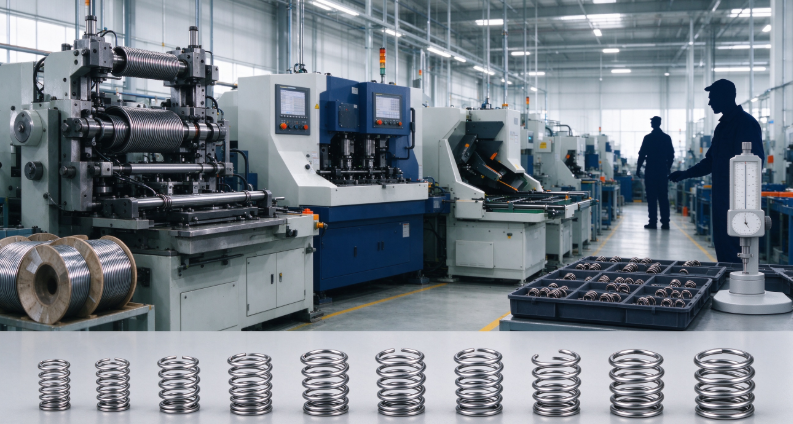
The integrated manufacturer has in-house coiling, heat treatment, grinding, and inspection equipment. They control the process from wire to finished spring. When you buy from them, you're buying directly from the source. Lead times are predictable because they own the schedule. Quality issues can be traced and corrected because they own the process.
The processor buys wire, coils springs to order, and outsources heat treatment and surface finishing. They can offer more flexibility on small batch sizes, but they're dependent on external suppliers for critical process steps. If the heat treater has a backlog, your lead time extends.
The trader buys finished springs and resells them. Sometimes they hold stock. Sometimes they're just brokering a deal between you and a factory they've never visited. This model adds cost without adding capability. When a spring fails, the trader is often as helpless as you are.
Before you discuss price, ask which model you're dealing with. The answer determines how much control the supplier actually has over your order.
What to Ask That Most Buyers Never Do
Every supplier will tell you they offer competitive prices and reliable delivery. Those are table stakes. The real information comes from specific questions that require specific answers.
Ask them to walk you through their quality control process for a custom spring. Not the general process. Their process. At what stage is wire diameter measured? How is coil diameter verified? How often is load testing performed? What happens when a measurement falls outside tolerance? A manufacturer will answer these questions in detail. A trader will pivot to talking about their relationships with factories.
Ask them what happens when a batch fails. Not if—when. Every coiling machine produces off-spec springs occasionally. The difference is what the supplier does with them. Do they catch it before it ships? Do they notify you before you discover it on the assembly line? Do they replace it at their cost, or do they argue about whether the failure was your fault? A supplier with a dedicated inspection workspace and documented testing protocols will have a clear answer. A supplier without them will improvise.
Ask them for the material grade and mill certificate. Spring materials aren't all the same. SS304 and SS316 are both stainless, but they perform differently in corrosive environments. Music wire and oil-tempered wire have different fatigue characteristics. A serious supplier will tell you exactly what wire they're using and provide a Mill Test Certificate to prove it. A supplier who can't name their wire source is a supplier who doesn't control their own supply chain.
A Framework for Comparing Spring Manufacturers
Here's how I structure supplier evaluations when the stakes are high enough to warrant the effort.
Evaluation Criteria | What Good Looks Like | Warning Sign |
|---|---|---|
Business model | Manufacturer with in-house coiling, heat treatment, and inspection | Trader with no visible facility |
Quality control | Documented in-process inspection with records available | Verbal assurance, no test data |
Material traceability | Mill Test Certificate per wire lot | "Standard material" with no documentation |
Drawing review | Engineering feedback before production | Production starts without confirming specs |
Prototype capability | Willing to produce sample batch for approval | Requires full production run for first order |
Lead time accuracy | Historical performance data available | Quoted times that change after deposit |
Technical support | Engineer or technician available for consultation | Salesperson who can't answer technical questions |
The last two rows matter more than most buyers realize. A supplier who can't answer a technical question about spring rate or fatigue life isn't a supplier. They're an order-taker. And a supplier who won't produce a prototype is a supplier who doesn't want you to test their work before you commit.
Material Selection: Where Every Sourcing Decision Starts
The wire material is the single most important factor in spring performance. It determines fatigue life, corrosion resistance, temperature limits, and cost.
Music wire (ASTM A228) is the standard for small, high-performance compression and extension springs. It has the highest tensile strength of the common spring materials and excellent fatigue resistance. The limitation is corrosion resistance. Music wire is plain carbon steel and will rust without a protective coating.
Oil-tempered wire (ASTM A229) is similar to music wire but with better uniformity and slightly lower tensile strength. It's used for larger wire diameters where music wire isn't available.
Stainless steel 302 and 304 are the workhorses for corrosion-resistant applications. They offer good fatigue resistance and excellent corrosion resistance in most environments. SS316 provides even better corrosion resistance for marine and chemical applications. Stainless springs are often specified for food processing, medical devices, and outdoor equipment.
Chrome vanadium steel (ASTM A231) is used for high-stress applications like automotive suspension springs. It offers excellent fatigue life and can handle higher operating temperatures than carbon steels.
Chrome silicon steel (ASTM A401) is similar to chrome vanadium but with better performance at elevated temperatures. It's specified for high-performance engine valve springs and other demanding applications.
Material | Fatigue Resistance | Corrosion Resistance | Max Operating Temp | Best For |
|---|---|---|---|---|
Music Wire | Excellent | Poor (requires coating) | ~120°C | Precision mechanisms, electronics |
Oil-Tempered Wire | Good | Poor (requires coating) | ~120°C | General purpose, larger diameters |
SS 302/304 | Very Good | Excellent | ~250°C | Food processing, outdoor equipment |
SS 316 | Very Good | Superior | ~250°C | Marine, chemical, medical |
Chrome Vanadium | Excellent | Moderate | ~220°C | Automotive suspension, high stress |
Chrome Silicon | Excellent | Moderate | ~250°C | Engine valve springs, high temp |
That comparison draws from standard industry specifications for spring wire materials. Your actual selection depends on the specific load, cycle life, and environment of your application.
A Real Case Study: When the Wrong Material Cost 40%
An industrial equipment manufacturer I worked with was sourcing compression springs for a hydraulic valve assembly. The original specification called for music wire with a zinc plating for corrosion protection. The springs worked fine in laboratory testing and passed initial qualification.
But in the field, the failures started. Springs were breaking at a rate of 3% within the first six months. The zinc plating was wearing through at the contact points, exposing the carbon steel underneath. In the humid operating environment, corrosion pits formed at those points and became crack initiation sites.
We ran the failure analysis and the data was clear. The combination of cyclic stress and corrosion had reduced the fatigue life below the design requirement. The springs weren't overloaded. They were underprotected.
The fix was a material change to SS 302. The stainless steel eliminated the corrosion issue entirely. The fatigue life in the actual operating environment exceeded the design target by a factor of two. The unit cost increased by 40%, but the warranty claim rate dropped to zero.
The lesson is straightforward. The cheapest material that passes a lab test is not necessarily the right material for the application. Corrosion fatigue is a real failure mode, and it doesn't show up in standard qualification testing.
What to Prepare Before Contacting a Manufacturer
A spring manufacturer can only give you an accurate quote if you give them complete information. Here's what to have ready.
The spring drawing. If you have an existing drawing, send it. If you don't, the supplier can often help create one, but it adds time. The drawing should include wire diameter, outer diameter, free length, total coils, end type, and load specifications.
Material preference. If you know what material you need, specify it. If you don't, describe the operating environment—temperature, moisture, chemicals, cycle frequency—and let the supplier recommend a material.
Quantity. Unit cost drops sharply between 100 and 10,000 units due to amortized setup costs. Spring manufacturers often have minimum order quantities (MOQs) ranging from 500 to 5,000 pieces for custom designs.
Application context. What does the spring do? Is it a return spring, a load-bearing spring, a torsion spring for rotational resistance? The application determines the critical performance parameters.
Quality requirements. Do you need a Mill Test Certificate? Do you need load testing data for each batch? Do you need PPAP documentation for automotive? Being clear about quality requirements upfront prevents surprises later.
Frequently Asked Questions
What's the minimum order quantity for custom springs?
Most manufacturers set an MOQ of 500 to 5,000 pieces, depending on the wire diameter and complexity. Small wire diameters (under 2mm) often allow lower MOQs because the setup cost is lower. For prototype or trial orders, some suppliers will accommodate smaller quantities at a premium.
How do I verify the material grade of the springs I receive?
Ask for a Mill Test Certificate for the wire lot used in your order. The MTC should list the chemical composition and mechanical properties of the wire. For critical applications, you can also send samples to an independent lab for verification.
What's the difference between hot coiling and cold coiling?
Hot coiling involves heating the wire before forming, which allows larger wire diameters (over 12mm) to be coiled without cracking. Cold coiling is used for smaller diameters and produces springs with tighter tolerances. The process choice affects the spring's residual stress state and fatigue performance.
Can I get a prototype before committing to a production order?
Yes, and you should. Any serious manufacturer will produce a prototype or sample batch for approval before mass production. Expect to pay for the prototype if the tooling or setup is complex. The cost is almost always worth it compared to the risk of a failed production batch.
How do I handle quality issues with a new supplier?
Establish clear acceptance criteria in your purchase order. Require dimensional inspection reports and load test data for the production batch. Inspect incoming material before it goes into assembly. If there's an issue, document it immediately and notify the supplier. A good supplier will resolve it. A bad one will blame you.
The Bottom Line
Sourcing custom springs is not about finding the lowest price per piece. It's about finding a manufacturing partner who understands your application, controls their own processes, and can reproduce your specification consistently. Check their material sourcing. Verify their quality control. Test a prototype before you commit to volume. And match the material to the actual operating environment, not just the lab test.
The spring is a small component with an outsized impact. A failed spring can stop a production line, strand a vehicle, or cause a safety incident. Choose your supplier accordingly.