I've reviewed hundreds of spring specifications over the years, and the conversation almost always starts the same way. An engineer sends me a drawing and asks for a quote. I look at the drawing and ask one question: what is the spring supposed to do? More often than I'd like, the answer is a long pause.
That pause is the problem. Spring selection starts with the application, not the drawing. The type of spring—compression, extension, or torsion—determines how it stores and releases energy, how it mounts, and how long it lasts. Choosing the wrong type means either overpaying for performance you don't need or, worse, under-specifying and getting a spring that fails in service.
This guide is about matching the spring type to the job. It's the conversation you should have before you ever send a drawing to a manufacturer.
The Fundamental Difference Between Spring Types
All three spring types store mechanical energy. The difference is how they store it and how that energy is released.
Compression springs store energy when they're compressed. They resist a pushing force. The coils are wound with space between them, and when a load is applied, that space closes. The spring pushes back against the load.
Extension springs store energy when they're stretched. They resist a pulling force. The coils are wound tightly against each other in the resting position, and when a load is applied, the coils separate. The spring pulls back against the load.
Torsion springs store energy when they're twisted. They resist a rotational force. The coils are wound tightly, and the ends are formed into legs that extend outward. When a torque is applied to the legs, the coil tightens or loosens, and the spring resists the rotation.
That's the physics. But the practical differences go much deeper.
Compression Springs: The Load Bearers
Compression springs are the most common type. They're used in everything from ballpoint pens to automotive suspension systems. If you need a spring that pushes back against a load, this is the starting point.
The key parameters for a compression spring are wire diameter, outer diameter, free length, solid height, spring rate, and end type.
Wire diameter determines the spring's strength and stress level. A thicker wire can carry more load but requires more force to compress. Outer diameter affects the spring's stability—a spring with a large diameter relative to its length is more prone to buckling. Free length is the spring's length when no load is applied. Solid height is the length when the coils are fully compressed and touching. Spring rate is the amount of force required to compress the spring by a unit of distance, usually expressed in N/mm or lbs/in.
End type matters more than most buyers realize. Closed and ground ends provide a flat surface for the spring to sit on, which improves stability and load distribution. Closed ends without grinding are cheaper but less stable. Open ends are used for applications where the spring sits in a pocket or on a rod.
Compression springs have zero load at zero deflection. That's a critical distinction from extension springs, which can be wound with initial tension.
Parameter | What It Determines | Typical Range |
|---|---|---|
Wire diameter | Strength, stress level | 0.1mm – 25mm |
Outer diameter | Stability, fit in assembly | 1mm – 500mm |
Free length | Travel range | Variable |
Spring rate | Load per unit deflection | Depends on design |
End type | Stability, mounting | Closed & ground, closed, open |
Extension Springs: The Pullers
Extension springs are used where a pulling force is needed. Garage door counterbalance systems, trampoline springs, and retractable cords all use extension springs. They're generally more affordable than torsion springs and easier to mount in some configurations.
The unique characteristic of an extension spring is initial tension. When the coils are wound tightly together, the spring can be manufactured with a built-in tension that must be overcome before the coils begin to separate. This initial tension is useful for applications where you want the spring to hold a minimum force even at zero deflection.
The end configuration is the most critical design element for extension springs. The spring needs to attach to something, and the hook, loop, or end shape determines how the load is transferred. Common end types include machine hooks, side hooks, extended hooks, and threaded inserts. A poorly designed hook becomes a stress concentration point and will fail before the spring body does.
Extension springs typically have a shorter lifespan compared to torsion springs because they experience significant stretching during operation. Unlike torsion springs, which are often mounted securely, extension springs may require additional safety cables or containment systems to prevent potential hazards if they fail. That's a real design consideration for any application where a broken spring could cause injury or damage.
Torsion Springs: The Twisters
Torsion springs are used where resistance to rotation is needed. Clothespins, mousetraps, and automotive door hinges all use torsion springs. They're designed to resist twisting forces rather than axial tension or compression.
The key parameters for a torsion spring are wire diameter, coil diameter, number of coils, leg length, and leg angle. The spring rate for a torsion spring is expressed in torque per degree of rotation, not force per unit of linear deflection.
Torsion springs can be designed to wind in either direction—clockwise or counterclockwise. Specifying the wrong direction means the spring will unwind when you apply torque instead of resisting it. This sounds obvious, but it's one of the most common specification errors I see.
The legs are the most fragile part of a torsion spring. They're subject to bending stress during installation and operation. A leg that's too short or too thin will bend or break before the coil fails. The leg design needs to account for how the spring will be mounted and how the torque will be applied.
Spring Type | Energy Storage | Mounting | Key Design Parameters |
|---|---|---|---|
Compression | Pushing force | Pocket, rod, flat surface | Wire dia, OD, free length, rate, end type |
Extension | Pulling force | Hooks, loops, threaded ends | Wire dia, OD, initial tension, end type |
Torsion | Rotational force | Legs against fixed points | Wire dia, coil dia, leg length, wind direction |
Beyond the Big Three: Special Geometries
Standard compression, extension, and torsion springs cover most applications. But some designs need different force-deflection characteristics that a straight cylindrical spring can't provide.
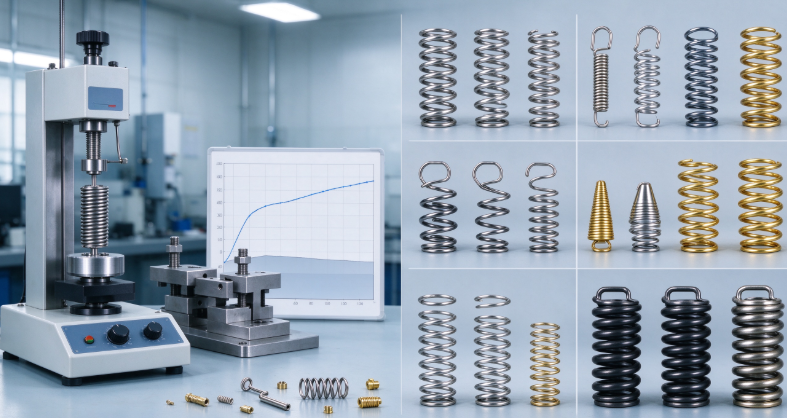
Tapered springs have a larger diameter at one end that gradually decreases toward the other. They offer a variable spring rate—the force increases progressively as the spring compresses. This is useful for applications that need a soft initial response and a stiffer response as the load increases. Tapered springs are also more resistant to buckling than straight cylindrical springs because the nested coils provide lateral support.
Barrel springs bulge in the middle and taper at both ends. They provide similar benefits to tapered springs, with better centering and stability under compression. Barrel springs are often used in applications where the spring needs to maintain alignment with the load path.
Conical springs are similar to tapered springs but with a more pronounced taper. They're used in applications where space is limited and a very low solid height is required. When fully compressed, the coils nest inside each other, allowing a much shorter solid height than a straight cylindrical spring.
Wire forms are not springs in the traditional sense. They're shaped wire components that perform a mechanical function—clips, brackets, retainers, hooks. They're often designed alongside springs in the same assembly and produced using similar equipment.
A Real Case Study: When the Spring Type Was the Problem
A manufacturer of industrial return mechanisms was using extension springs to return a lever to its resting position after actuation. The springs were failing at the hook after approximately 50,000 cycles. The design life was 500,000 cycles.
The initial assumption was that the spring material was inadequate or the stress was too high. But when we looked at the failure mode, the problem was obvious. The hook was experiencing a bending moment every time the spring extended. The hook geometry was creating a stress concentration that the spring body wasn't designed to handle.
We evaluated two options. The first was to redesign the hook to reduce the stress concentration. This was possible but would require a custom end configuration that increased cost.
The second option was to switch from an extension spring to a compression spring. By reversing the mechanism so that the spring was compressed rather than extended, we eliminated the hook entirely. The compression spring sat in a pocket on one side and pressed against a flat surface on the other. No stress concentration points. No hook failure mode.
The compression spring solution cost less, lasted longer, and was easier to assemble. The lesson wasn't about material or manufacturing. It was about spring type selection. The original design had defaulted to an extension spring because that's what had been used in a previous product. Nobody asked whether a different spring type would work better.
What to Prepare Before Contacting a Manufacturer
The more information you provide upfront, the faster and more accurate the quote will be. Here's what to have ready.
A drawing or sketch. It doesn't need to be a formal engineering drawing, but it should show the basic dimensions: wire diameter, coil diameter, free length, and end configuration.
The load requirements. What force does the spring need to exert? At what deflection? If you don't know the spring rate, tell the supplier the load you need to support and the available travel.
The operating environment. Temperature range, moisture exposure, chemical exposure, cycle frequency. This drives material selection.
The space available. How much room is there for the spring? What's the maximum diameter and length? This determines the design constraints.
The quantity. Prototype, small batch, or full production? This affects the manufacturing method and the tooling cost.
Frequently Asked Questions
Can a compression spring be used in tension?
No. Compression springs are designed for pushing loads. Applying a tensile load will pull the ends apart and destroy the spring. If you need a pulling force, use an extension spring.
What's the difference between initial tension and spring rate in an extension spring?
Initial tension is the force required to separate the coils before the spring begins to extend. Spring rate is the additional force required per unit of extension after the coils separate. Both are important for extension spring design.
How do I specify the wind direction for a torsion spring?
The wind direction determines whether the spring tightens or loosens when torque is applied. Clockwise and counterclockwise are the two options. The correct choice depends on the direction of rotation in your application. If you're unsure, provide the supplier with a drawing of the mounting and the direction of force application.
What's the maximum operating temperature for a compression spring?
It depends on the material. Music wire and oil-tempered wire are limited to roughly 120°C. Chrome vanadium and chrome silicon can handle up to 220°C to 250°C. Stainless steel grades vary but generally top out around 250°C. For higher temperatures, exotic alloys are required.
Can I use a standard spring instead of a custom one?
Sometimes. Standard springs are cheaper and available immediately. But standard springs are designed for general applications, not your specific load and space requirements. If the standard spring doesn't match your load curve and fit in your assembly, a custom spring is the better choice—even at higher unit cost.
The Bottom Line
Spring type selection is an engineering decision, not a purchasing decision. Compression, extension, and torsion springs each have distinct characteristics that make them suitable for specific applications. Choosing the wrong type means either overpaying for performance you don't need or under-specifying and getting a spring that fails in service.
Start with the application. What force needs to be applied? In what direction? Over what distance? Then select the spring type that matches those requirements. Only after that should you worry about material, dimensions, and supplier selection.