
If you've ever been tasked with fitting a spring into a tight assembly—and I mean really tight—you know the frustration. You've got the load requirements figured out. You know the deflection you need. But when you spec out a standard cylindrical compression spring, it just doesn't fit. Either the solid height is too tall, or the spring buckles under compression, or the spring rate just isn't right for what you're trying to do.
I've been in enough design reviews to know that spring selection often gets treated as an afterthought. And honestly? That's a mistake. The spring you choose affects everything from assembly space to dynamic performance to long-term reliability. And when you're dealing with space constraints or nonlinear load requirements, the difference between a cylindrical spring and a conical spring can make or break your design.
Let's walk through what actually matters when you're deciding between these two types.
What Are Conical and Cylindrical Compression Springs?
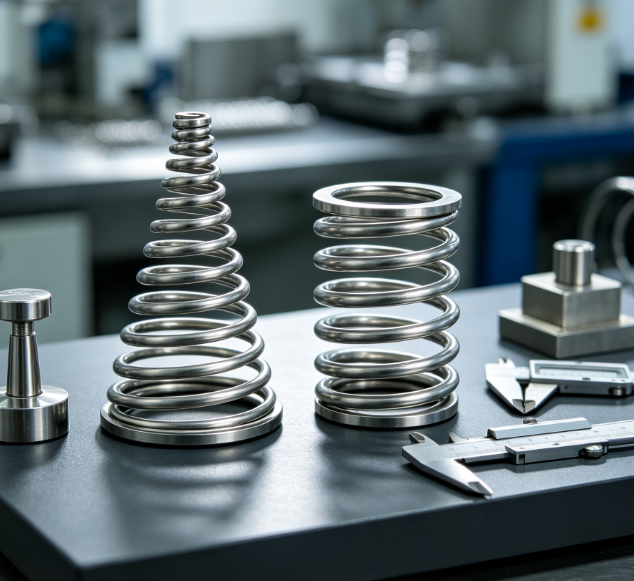
Let's start with the obvious. A cylindrical compression spring—what most people picture when they hear "coil spring"—has a constant diameter from top to bottom. The coils are wound with a consistent inner and outer diameter throughout the length of the spring. It's straightforward. It's predictable. And it's been the workhorse of the industry for decades.
A conical compression spring, on the other hand, is wound in the form of a helix on a conical geometry. The coil diameter varies along the length—larger at the base and progressively smaller toward the top. Some people call them tapered springs or variable-diameter springs.
Here's the key difference that drives everything else. When a conical spring is compressed, the smaller coils at the top can nest inside the larger coils below them. This "telescoping" or "nesting" effect is what gives conical springs their unique advantages—and their unique challenges.
The Space-Saving Advantage: Solid Height Comparison
This is where conical springs really shine. And I mean really shine.
The solid height of a spring is the length of the spring when it's fully compressed—when all the coils are touching. For a cylindrical spring, the solid height is essentially the wire diameter multiplied by the number of coils. If you've got 10 coils of 2mm wire, your solid height is around 20mm. Simple math.
But for a conical spring? The nesting effect changes everything. Because the smaller coils fit inside the larger ones, the solid height can be reduced to approximately one or two wire diameters. That's it. Not 20mm. Two millimeters.
Let me put that in perspective. A conical compression spring with the same number of active coils as a cylindrical spring can collapse to a solid height that's dramatically shorter—far shorter than what you could achieve with a cylindrical design. The coils telescope into one another during compression, resulting in a much lower solid height.
This is why you see conical springs specified in applications where installation height is limited. Think about it. If you've only got 15mm of vertical space to work with, a cylindrical spring with a 20mm solid height simply won't work. A conical spring with a 2mm solid height? That fits.
Load Response: Linear vs. Nonlinear Behavior
Now let's talk about how these springs actually behave under load. Because this is where things get interesting—and where a lot of engineers get tripped up.
Cylindrical Springs: Linear and Predictable
A standard cylindrical compression spring with constant pitch exhibits a linear load-deflection relationship. Double the load, double the deflection. It's simple. It's predictable. And for many applications, that's exactly what you want.
The spring rate—measured in Newtons per millimeter or pounds per inch—remains constant throughout the spring's travel. You can calculate it with a straightforward formula. No surprises.
Conical Springs: Nonlinear and Progressive
A conical spring? Different story entirely. The behavior of a conical compression spring has both linear and nonlinear phases. As the spring compresses, the smaller coils at the top begin to bottom out against the larger coils below them. Each coil that goes solid removes itself from the active coil count, which increases the spring rate progressively.
The result is a progressive spring rate. The more you compress it, the stiffer it gets. At the beginning of the stroke, the spring is relatively soft. As deflection increases, stiffness increases.
This nonlinear characteristic is valuable in applications where you want a soft initial response but firm bottoming resistance. Think about a vehicle suspension that needs to absorb small bumps comfortably but also handle large impacts without bottoming out. A conical spring can provide exactly that behavior.
Buckling and Stability Considerations
Here's something that surprises a lot of people. Despite what you might think, conical springs don't necessarily have better buckling resistance than cylindrical springs.
A study comparing critical buckling loads for mass-equivalent conical and cylindrical springs found that the conical spring actually has a lesser critical load than the cylindrical spring. Table 12 from that comparison shows a cylindrical spring with a critical buckling load of 123.613 N (compressive) compared to 101.842 N for the conical spring.
Now, that sounds like a disadvantage—and in some ways it is. But here's the nuance. While the conical spring may have a lower critical buckling load, its larger base diameter serves as a stable platform during operation. The unique design and nesting ability help prevent buckling in practical applications, making them ideal where buckling is a concern.
The key takeaway? Don't assume one is inherently more stable than the other. The buckling behavior depends on the specific geometry, the load conditions, and how the spring is guided in your assembly.
Key Applications for Each Spring Type
Cylindrical Compression Springs
These are your go-to for most general-purpose applications. They're simple to manufacture, easy to calculate, and well-understood. You'll find them in:
General industrial machinery
Automotive suspension (though conical is gaining ground here)
Valve assemblies
Consumer products
Any application where linear spring rate is desired
Conical Compression Springs
Conical springs are specified when you need one of three things: space savings, progressive spring rate, or both. Common applications include:
Automotive suspensions: Where space is limited and progressive rate is beneficial
Valve systems: Where variable spring rate minimizes vibrational problems and provides high initial closing forces with low final closing forces
Electrical switches and electronic components: Where compact size is critical
Heavy machinery: Where high load capacity and space optimization are required
Aerospace and defense: Where reliability and compactness are paramount
Conical compression springs are widely used across sectors including electronics, automotive, appliances, medical devices, textiles, automation, pneumatics, hydraulics, and electrotechnics.
Real-World Case Study: Automotive Suspension Application
Let me share a case that really illustrates the difference between these two spring types.
A comparative finite element analysis was performed on a shock absorber application, evaluating both cylindrical and conical compression springs. The results were striking.
The cylindrical spring design showed limited deflection of 45 mm at 700 N. The conical spring, under the same analysis conditions, operated at 2000 N with 80 mm deflection. That's nearly three times the load capacity with almost double the deflection.
But here's what really caught my attention. The conical spring showed maximum compression, negative solid height, and better oscillation characteristics compared to the cylindrical spring. The conical suspension spring demonstrated potential to achieve negative solid height, constant spring rate, and smooth oscillation due to its physical design.
What does "negative solid height" mean in practical terms? It means the spring can compress beyond what would be the solid height of a comparable cylindrical spring. The coils nest so efficiently that the spring essentially disappears into itself.
The study concluded that conical springs have potential for improved structural performance in shock absorber applications. The combination of higher load capacity, greater deflection, and better oscillation damping made them superior for that particular application.
Frequently Asked Questions
What's the main advantage of a conical spring over a cylindrical spring?
Space savings and progressive spring rate. The nesting effect allows conical springs to achieve a much lower solid height—sometimes as low as one or two wire diameters—while the varying coil diameter creates a progressive (nonlinear) load-deflection characteristic.
When should I choose a cylindrical spring?
Choose cylindrical springs when you need a linear spring rate, when space isn't a constraint, or when you want the simplest, most predictable design. They're also generally less expensive to manufacture than conical springs.
When should I choose a conical spring?
Choose conical springs when you have limited installation height, when you need a progressive spring rate, or when you want to avoid buckling in a compact package. They're ideal for automotive suspensions, valve systems, and any application where space is at a premium.
Do conical springs buckle more easily than cylindrical springs?
The data shows that conical springs have a lower critical buckling load than mass-equivalent cylindrical springs. However, the larger base diameter provides stability during operation, and proper design can mitigate buckling concerns.
What's the solid height of a conical spring compared to a cylindrical spring?
A conical spring can achieve a solid height approximately equal to one or two wire diameters. A cylindrical spring's solid height is roughly the wire diameter multiplied by the number of coils—significantly taller for the same number of active coils.
Can a conical spring provide a linear spring rate?
Yes, conical springs can be designed with either linear or progressive spring rates. The design parameters—including the rate of diameter change and the pitch—determine the load-deflection characteristic.
Final Thoughts
Look, I've been around enough design tables to know that spring selection often comes down to habit. "We've always used cylindrical springs" is something I hear all the time. And for many applications, that's perfectly fine. Cylindrical springs are simple, predictable, and cost-effective.
But if you're dealing with space constraints? If you need a progressive spring rate? If you want to reduce solid height without sacrificing travel? Conical springs deserve a serious look.
The numbers don't lie. A conical spring can deliver nearly three times the load capacity at almost double the deflection compared to a cylindrical spring in the same envelope. The solid height can be reduced to a fraction of what a cylindrical spring requires. And the progressive spring rate provides a level of performance tuning that simply isn't possible with a constant-diameter design.
That said, conical springs aren't a silver bullet. They're more complex to design and manufacture. The buckling behavior requires careful attention. And the nonlinear characteristics might not be what you want for every application.
The right choice depends on your specific requirements—available space, load conditions, deflection needs, and cost constraints. But if you haven't considered conical springs for your next project, you might be leaving performance and packaging efficiency on the table.
Choose wisely. And don't be afraid to challenge the "we've always done it this way" mentality. Sometimes the best solution isn't the one you've been using for years—it's the one you haven't tried yet.